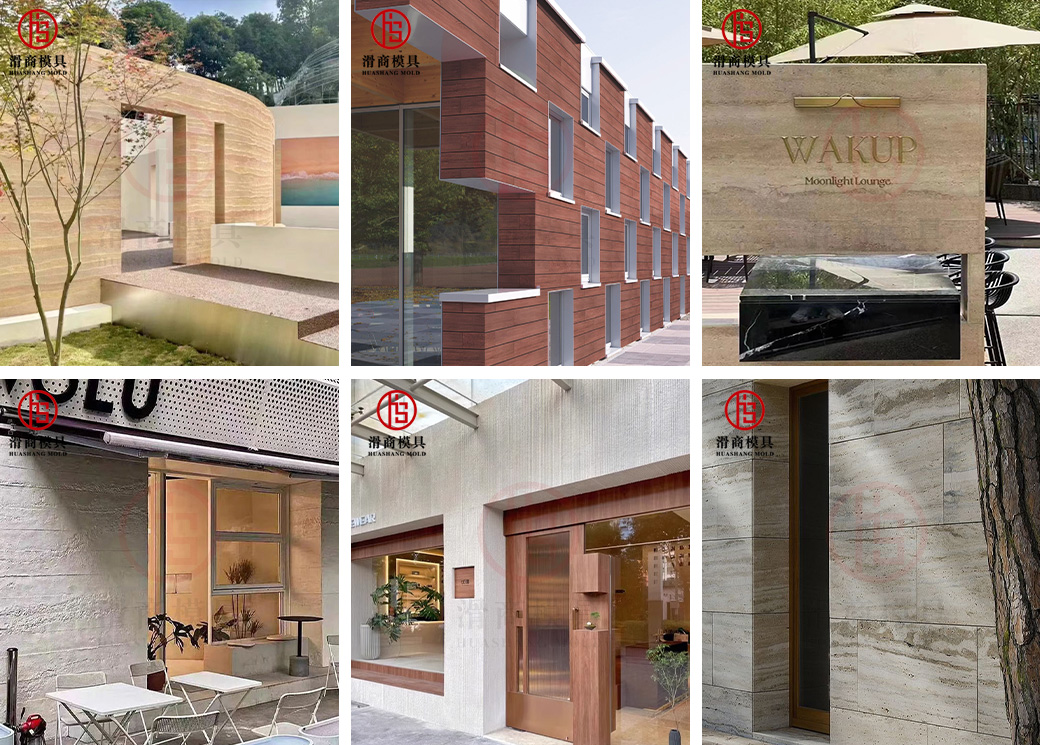
1. Installation Instructions
Finished flexible ceramic (MCM flexible stone veneer) is a new type of lightweight, flexible, eco-friendly decorative material, widely suitable for interior and exterior wall renovation, old building facade renovation, villa decoration, commercial space finishing and various curved wall decoration projects. The whole construction process adopts professional thin-layer full-bonding process, which is different from traditional tile pasting, featuring light weight, strong adhesion and good crack resistance.
Before formal construction, the base wall surface must be fully treated to meet construction standards. The substrate shall be firm, integral, flat and dry, completely free of floating dust, oil stains, loose mortar, peeling layers and sundries. For newly plastered walls and cement base surfaces with high alkalinity, it is mandatory to coat with professional alkali-resistant interface primer to isolate wall alkalinity, prevent alkali return and discoloration of the finished soft ceramic, and ensure long-term bonding stability. During installation, use special flexible adhesive mortar matched with soft ceramic products, evenly coat the adhesive on the base surface or the back of the plate with a scraper, ensure full coverage of the adhesive layer without missing coating or sparse coating. After pasting each plate, knead and press it evenly and firmly to discharge internal air, completely eliminate hollowing, warping and edge lifting problems.
2. Key Installation Precautions
– Substrate Requirements: The base wall must be structurally stable, firm and free of hollowing, sanding, cracking and peeling. The surface flatness error shall not exceed 3mm per meter, and the base moisture content shall be controlled within 10%. All dust, oil stains, floating ash and residual sundries on the wall must be completely cleaned before construction.
– Material Matching Requirements: All supporting construction materials must be matched special flexible adhesive mortar and flexible grout for soft ceramics. It is strictly prohibited to use ordinary ceramic tile adhesive, cement mortar and rigid grout for construction. Ordinary rigid materials cannot adapt to the flexible deformation characteristics of soft ceramics, which will easily cause problems such as adhesive failure, hollowing, cracking, edge warping and overall falling off in the later stage of use. All materials shall be stored in a dry and ventilated environment, avoiding dampness, exposure and expiration use, to ensure the construction effect and bonding quality.
– Pasting and Construction Process Standards: The full mortar kneading and pasting process must be adopted for all plates, realizing full fitting between the plate and the base surface without hollow gaps and local empty bonding. During the pasting process, adjust the flatness and gap uniformity of the plates in real time to avoid dislocation and uneven joints. Uniform expansion joints must be reserved between adjacent plates, and hard splicing and forced extrusion are strictly